
Proof of Human
- Published
- 21 Sept 2026
- Read
- 9 min read
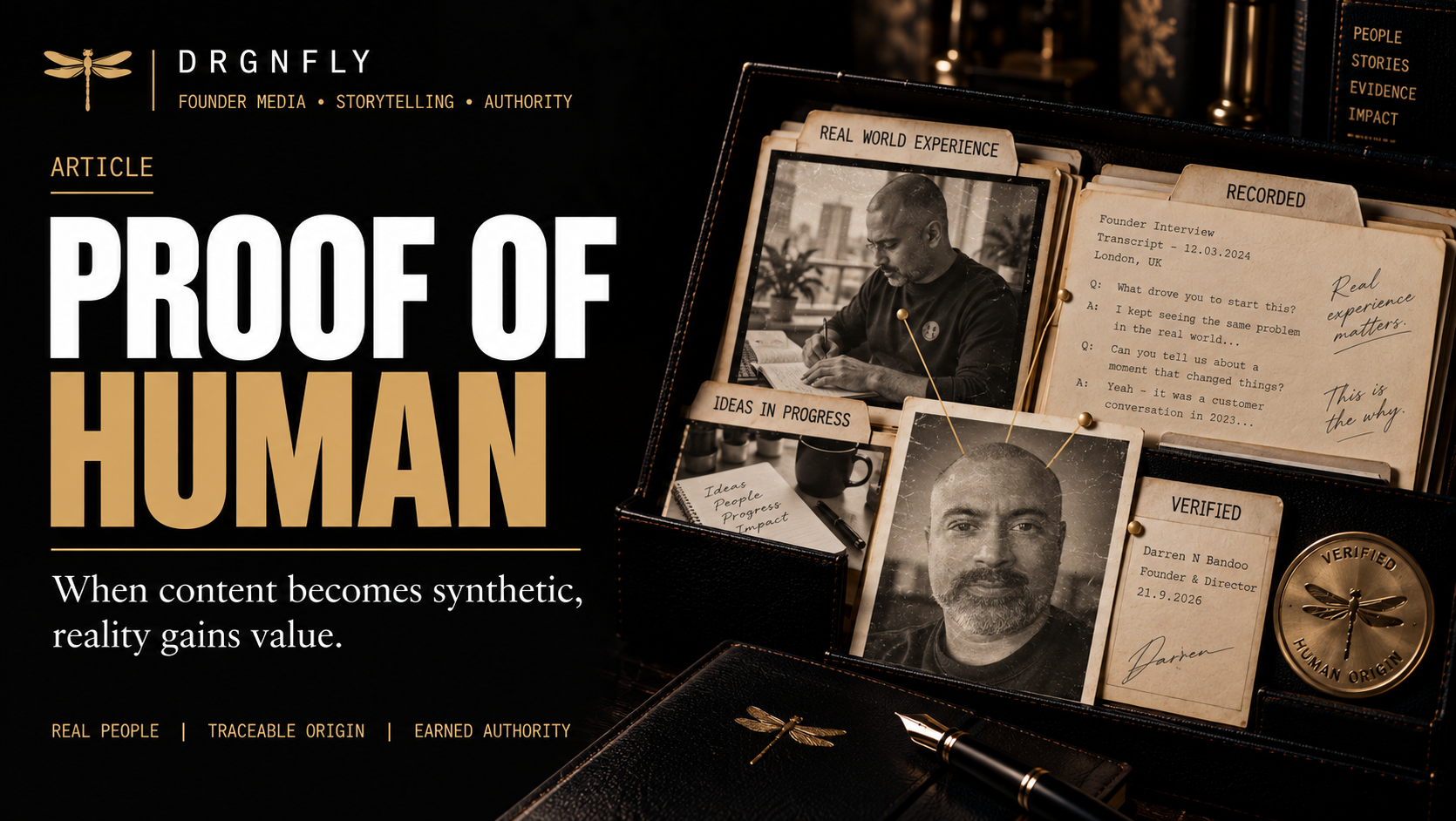
When content becomes synthetic, reality gains value.
Almost any business can now produce polished content at extraordinary speed.
Articles can be drafted in seconds. Images generated without cameras. Voices cloned. Presenters created without anyone stepping in front of a lens.
The production barrier is collapsing.
That's useful. Small teams can move faster, founders can develop ideas more efficiently and businesses can produce media that once required much larger budgets.
But when almost anything can be generated, another question becomes more important:
What actually happened?
Did this person really say that?
Has this company genuinely done the work?
Does the founder understand the subject—or have they simply published a convincing approximation of expertise?
The next competitive advantage may not be producing more content.
It may be proving where it came from.
Key Takeaways
Polish is becoming easier to manufacture. Experience isn't.
Original interviews, projects, conversations and documentation are becoming evidence as well as content.
AI is most powerful when it extends genuine expertise rather than manufactures its appearance.
Provenance is moving rapidly into mainstream media technology.
A well-built Archive can become a traceable history of what a business knows and why it has earned the right to know it.
Polish Is No Longer Proof
For years, production quality acted as a proxy for credibility.
A well-written article suggested expertise. Professional photography implied access. A polished video demonstrated investment.
Those assumptions are weakening.
AI can already reproduce many of the surface signals we associate with authority: confidence, clarity, sophistication and increasingly, personality.
LinkedIn is already responding to this shift. In June, it announced measures to reduce the reach of what it describes as low-effort AI content that appears polished but lacks genuine perspective or substance. Its systems are increasingly looking for perspective, context and expertise, rather than polish alone. (LinkedIn Pressroom)
Interestingly, LinkedIn has also reported that posts showcasing actual projects and products increased 4.5× year-on-year, while introducing features designed to turn verified real-world activity into visible evidence of expertise. (LinkedIn Pressroom)
The signal is becoming clearer:
Saying you know something and demonstrating why you know it are becoming different things.
The Value Is Moving Behind the Content
The most defensible part of a brand's media may increasingly be what sits behind the finished asset.
The original interview.
The founder's unpolished explanation.
The footage from the site visit.
The client describing what changed.
The photographs showing the work in progress.
The decisions and outcomes that demonstrate how something was actually done.
We often think of these things as production material.
But they're also evidence.
They show that the people existed, the conversation happened, the work was undertaken and the experience was earned.
This connects directly with something we've explored before in The Archive Is The Business: the source material behind published content shouldn't simply disappear once the post goes live.
Because now it carries another kind of value.
Provenance.
Proof of Human Doesn't Mean Anti-AI
AI is going to become embedded throughout media production.
We already use it across research, transcription, editing, analysis, repurposing and discovery.
The interesting distinction isn't human versus AI.
It's source versus synthesis.
AI can analyse years of founder interviews.
It cannot have the experiences contained within them.
It can produce a polished explanation.
It cannot make the decisions that made the explanation worth hearing.
The human contribution isn't valuable because it's inefficient.
It's valuable because it's the source.
Provenance Is Becoming Infrastructure
This idea is already moving beyond editorial theory.
The Coalition for Content Provenance and Authenticity (C2PA) has developed Content Credentials: an open standard designed to provide tamper-evident information about where digital content came from and how it was altered. Its July 2026 guidance specifically addresses identifying synthetic and non-synthetic media. (C2PA)
Adobe has now brought Content Credentials directly into tools including Premiere, allowing creators to attach provenance information when media is exported. (Adobe Help Center)
Technical credentials don't prove that a claim is true—and C2PA itself is careful about that distinction. They establish information about the history of the media rather than making a judgement about its truthfulness. (C2PA)
For businesses, we think there is a second layer.
A Content Credential can help establish the history of a file.
A media Archive can establish the history of the expertise.
Who said it?
What project produced the insight?
What happened?
What changed?
What evidence sits behind the claim?
That's where provenance becomes editorial.
Your Archive Becomes Part of Your Reputation
Most businesses still treat media as finished outputs.
Publish the video. Post the photographs. Finish the campaign. Move on.
But the source material may increasingly be as valuable as the finished content.
Interviews. Transcripts. Project documentation. Founder observations. Client testimony. Behind-the-scenes footage. Decisions, lessons, dates and participants.
Preserved properly, these create more than a content library.
They create a record of organisational experience.
Claims can be connected to examples.
Opinions can be traced back to lived experience.
New ideas can build upon previous conversations.
And expertise gains something increasingly valuable:
a chain of evidence.
For founder-led businesses, that chain can be particularly powerful:
Experience → Perspective → Documentation → Media → Authority
Competitors may copy the topic.
They may imitate the format.
Increasingly, they may even approximate the voice.
But they cannot own the same history.
The Content Question Is Changing
For years we've asked:
What should we publish?
Perhaps we now need to ask:
What can we prove?
Record the conversations.
Document the process.
Photograph the work.
Preserve the source material.
Connect ideas to real projects, decisions and outcomes.
Because synthetic content will continue to improve.
The brands that stand out won't simply be those that look human.
They'll be the ones capable of demonstrating that real people, real work and real experience sit behind what they publish.
When content becomes synthetic, reality gains value.
5 Key Thoughts
- 01Polish is no longer proof.
Production quality can increasingly be generated. Experience still has to be earned.
- 02Source material is becoming an asset.
Interviews, footage and documentation aren't leftovers. They're evidence.
- 03AI should extend expertise, not manufacture its appearance.
- 04The Archive is becoming a chain of evidence.
It preserves not only what a business knows, but where that knowledge came from.
- 05Proof of human creates differentiation.
When synthetic media becomes abundant, documented human experience becomes comparatively scarce.
Related Articles
Why Human Perspective Is Becoming More Valuable Than Ever
As competent synthetic content becomes abundant, lived experience and original perspective become harder to replicate.
Why preserving conversations, expertise and source material creates an asset that compounds beyond individual posts.
Expertise Must Be Discoverable
Expertise only creates leverage when people—and increasingly machines—can find and understand it.
Content Is Becoming Corporate Infrastructure
Why media is becoming part of how organisations capture and preserve institutional knowledge.