
Your Next Audience Might Not Be Human
- Published
- 15 Sept 2026
- Read
- 9 min read
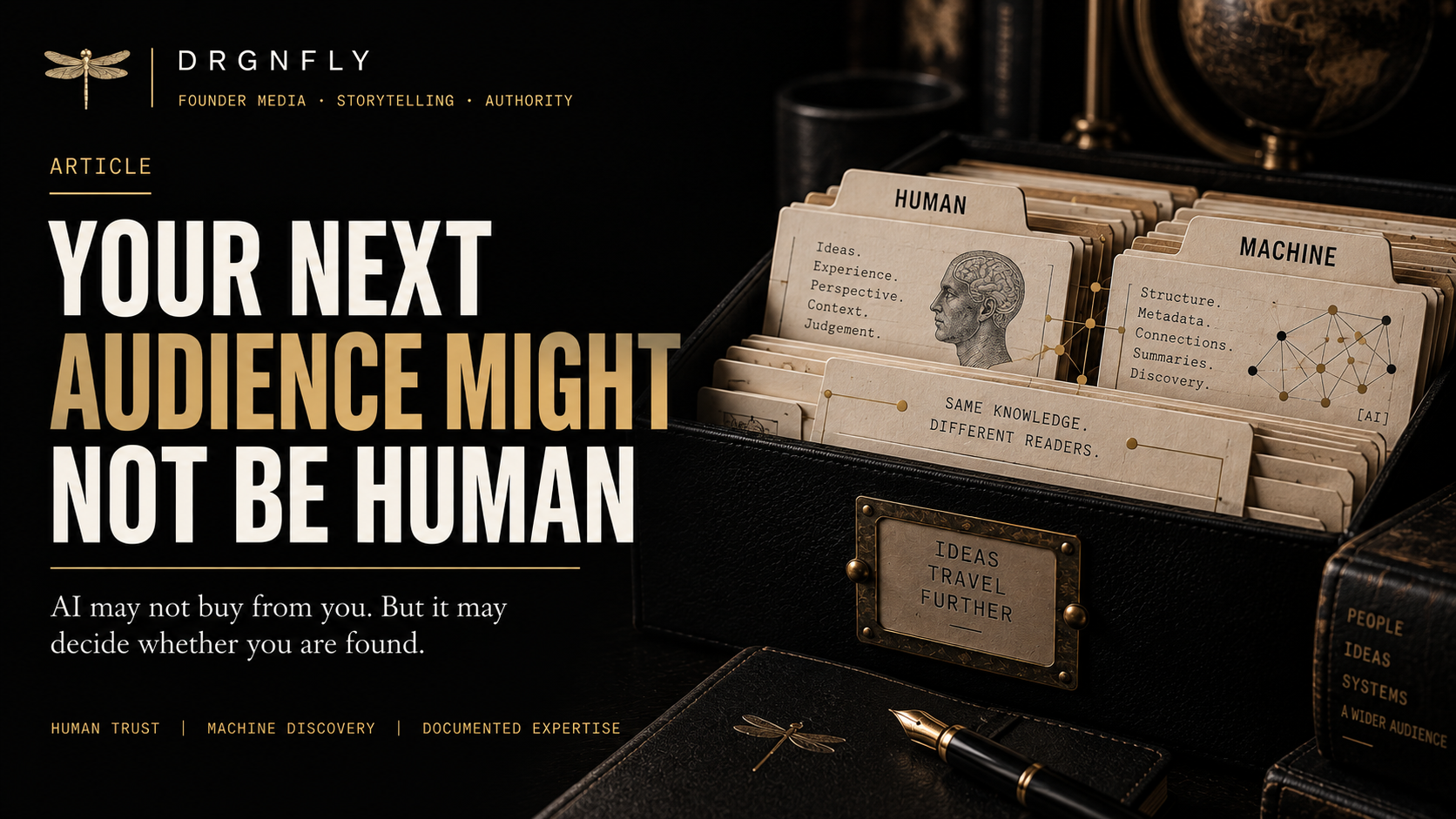
AI may not buy from you. But it may decide whether you are found. Your expertise now has two audiences: the person making the decision and the system helping them make it.
The next person to discover your business may never visit your website.
They may never see your LinkedIn post.
They may never read the article you spent three days writing.
Instead, an AI system may read it for them.
Key Takeaways
AI is becoming another layer between businesses and their potential customers.
Your expertise now has two audiences: the person making the decision and the system helping them make it.
A business can possess enormous knowledge while giving AI very little useful evidence of it.
Clear, original and well-structured content is becoming part of commercial visibility.
The objective is not to write for robots. It is to make genuine human expertise easier for machines to understand and surface.
Discovery Is Changing
For years, businesses have thought about digital visibility through two familiar routes.
Search helped people find you.
Social media helped people encounter you.
Both still matter.
But a third route is emerging.
People are increasingly asking AI systems to research options, compare providers, explain unfamiliar markets and recommend where to look next.
They are not always beginning with a list of websites.
They are beginning with a question.
“What should I consider before refurbishing a hospitality venue?”
“Which type of consultant do I need for this project?”
“What makes one founder-media strategy different from another?”
“Who appears to understand this problem properly?”
The system interprets the question, searches for relevant information, weighs the available evidence and constructs a response.
That response may mention a company.
It may cite an article.
It may recommend a particular approach.
Or it may overlook a business entirely because it cannot find enough useful evidence to understand what that business knows.
Your next audience may therefore be human.
But the route to that human increasingly passes through a machine.
This Is Already Happening at Scale
Google says people are increasingly using generative AI to find, organise and understand information.
As of August 2026, Google reported that AI Overviews had more than 2.5 billion monthly active users, while AI Mode had passed one billion. The company is now giving website owners information about which pages appear within AI-generated responses and guidance on improving visibility within generative search. Google’s update for website owners
Adobe’s research points in the same direction.
Its August 2026 AI Traffic Trends report states that AI referrals are now outperforming other channels on revenue and conversion, describing an emerging need to make content something AI systems can read, cite and recommend. Adobe AI Traffic Trends Report
This does not mean traditional search has disappeared.
It means discovery is being re-intermediated.
A growing number of customers may encounter a compressed interpretation of your expertise before they encounter your business directly.
That changes the role of content.
Your Business Now Has Two Audiences
Most business communication has traditionally been created for the person on the other side of the screen.
That remains the priority.
But published expertise now has another potential reader:
the system trying to understand what your business represents.
The human audience wants relevance, credibility and clarity.
The machine needs enough structured evidence to recognise:
what you know;
who you help;
the subjects you have genuine experience in;
how your ideas connect;
whether other credible sources reference you;
and whether your contribution adds anything beyond information already available elsewhere.
These are not entirely separate requirements.
Clear thinking tends to be easier for both people and machines to understand.
The problem is that many businesses have never properly articulated what they know in the first place.
Being Excellent Is Not the Same as Being Legible
A company may have twenty years of experience.
Its founder may possess unusually strong judgement.
Its team may solve complex problems every week.
Its clients may trust it completely.
But very little of that necessarily exists in a form an external system can interpret.
The knowledge may be trapped inside:
meetings;
proposals;
private conversations;
project debriefs;
presentations;
voice notes;
individual employees;
or the founder’s instinctive decision-making.
From inside the business, the expertise feels obvious.
From outside, it may be almost invisible.
This creates a new distinction:
expertise and machine-legible expertise are not the same thing.
Adobe found that significant portions of major retail websites could not be properly read by AI systems. In its analysis, the average machine-readability score for retail homepages was 75%, falling to 66% for product pages. Adobe argues that these gaps limit visibility within AI-generated search results. Adobe’s research into AI visibility
That research focuses on retail websites.
But the wider implication is relevant far beyond ecommerce.
If an AI system cannot understand your pages, your services or your expertise, it has less useful material with which to represent you.
This Is Not Another SEO Trick
There will inevitably be a new industry built around optimising content for AI.
Some of it will be useful.
Much of it will probably become another race to manufacture large volumes of technically compliant information.
We have seen this pattern before.
A new distribution system appears.
Businesses learn what it rewards.
Production increases.
Quality becomes uneven.
Tactics begin replacing substance.
But creating more machine-readable mediocrity is unlikely to be a durable advantage.
Google’s own guidance emphasises unique, non-commodity content created for readers, alongside clear organisation and strong supporting images and video.
That distinction matters.
The objective should not be to manipulate an AI system into mentioning you.
It should be to give the system accurate evidence of expertise that genuinely exists.
That requires more than optimisation.
It requires something worth discovering.
AI Can Only Work With the Evidence It Can Find
Imagine asking an AI assistant to identify the most credible hospitality architect for a particular project.
It cannot sit in on twenty years of client meetings.
It cannot observe how somebody handles pressure during a difficult build.
It cannot automatically know which architect understands operations as well as aesthetics.
It works with available signals.
Published articles.
Project documentation.
Interviews.
Case studies.
Professional references.
Clear service information.
Consistent ideas.
External coverage.
Video transcripts.
Evidence of completed work.
The quality of the recommendation is shaped by the quality of the accessible record.
This is why an archive of expertise is becoming more commercially important.
An archive gives a business somewhere to accumulate:
experience;
explanations;
decisions;
beliefs;
project evidence;
recurring observations;
and a recognisable body of thought.
It helps people understand the business.
It may also help machines understand enough to introduce that business to people who have never encountered it before.
The Website Is Becoming a Knowledge Source Again
Social media encouraged many businesses to treat their website as a digital brochure.
A few service pages.
Some attractive photographs.
A short About section.
Perhaps a blog that was enthusiastically updated for three months and then abandoned.
Most of the real thinking went elsewhere.
Into LinkedIn posts.
Podcast appearances.
Webinars.
Videos.
Email newsletters.
Platforms the business did not own.
AI discovery makes the owned website interesting again.
Not because every business needs to become a publisher.
Because a well-maintained website can become the clearest structured source of what that business knows.
Social posts can introduce an idea.
The website can preserve it.
An interview can reveal an insight.
The archive can connect it to related thinking.
A project can provide evidence.
The case study can explain the decisions and outcomes behind it.
Over time, the website stops behaving like a static shop window.
It becomes a knowledge base with a point of view.
The Opportunity Is Bigger Than Traffic
The immediate marketing question is obvious:
“How do we get mentioned in AI search?”
It is worth asking.
But it may be too narrow.
The more important question is:
“What would an intelligent system understand about our business from the evidence we have published?”
Would it understand your specialist expertise?
Would it recognise the problems you solve?
Would it see a coherent perspective across your articles, interviews and case studies?
Could it distinguish your thinking from the generic language used by everybody else in the category?
Would it find recent evidence that the business remains active and relevant?
Would it understand why a potential customer should trust you?
If the answer is no, the problem may not be an AI-visibility problem.
It may be a documentation problem.
You Should Not Sound Like a Machine to Reach One
There is an irony here.
As businesses become more aware of machine audiences, some will begin producing increasingly mechanical content.
More keywords.
More predictable structures.
More generic answers.
More pages written primarily to satisfy a system.
That may create volume.
It will not necessarily create authority.
AI systems already have access to enormous quantities of competent, generic information.
What they—and the people using them—need is credible material that contributes something distinctive.
First-hand experience.
Specific examples.
Clear arguments.
Original observations.
Named frameworks.
Documented outcomes.
A perspective that has developed through actually doing the work.
The content should still feel human because the underlying expertise is human.
Making it legible does not mean removing its personality.
It means organising the thinking clearly enough that its value can travel.
Start With What You Want to Be Understood For
The practical starting point is not:
“How do we optimise everything for AI?”
It is:
“What should our business be understood for?”
Choose the areas where the organisation has genuine authority.
Then examine the available evidence.
Have you explained the ideas?
Have you documented the work?
Have you captured the founder’s perspective?
Have you answered the questions customers repeatedly ask?
Have you published case studies that explain the thinking, rather than only showing the outcome?
Have you connected related articles so a reader—or system—can follow the body of thought?
Is the information current?
Is it clear who produced it and why they are qualified to speak?
This is not a one-off content exercise.
It is the gradual construction of a visible intellectual record.
Your Next Audience Might Not Be Human
The future customer is still human.
They still make the decision.
They still need to trust the business.
They still care whether the people behind it understand their world.
But the first encounter may increasingly be mediated by a system.
An AI assistant may decide which sources to cite.
A search summary may decide which perspectives to include.
A recommendation engine may decide which businesses appear relevant enough to investigate.
That does not reduce the value of human expertise.
It increases the importance of documenting it properly.
Because the machine cannot infer what you have never made visible.
It cannot cite the conversation that stayed inside the meeting room.
It cannot recommend the expertise buried inside one person’s head.
It cannot understand a business that has never clearly explained itself.
Your next audience might not be human.
But what it is looking for should be unmistakably so.
5 Key Thoughts
- 01Expertise now has two audiences. The person making the decision and the system helping them find, compare or understand their options.
- 02Machine readability begins with human clarity. Businesses must first articulate what they know before any technology can interpret it accurately.
- 03AI visibility is not simply a technical problem. It depends on credible evidence, original knowledge and a coherent body of published thought.
- 04Owned archives are becoming discovery infrastructure. They allow expertise to remain accessible, connected and reusable beyond the lifespan of an individual post.
- 05Do not remove the human to reach the machine. First-hand experience and distinctive interpretation are precisely what make expertise worth surfacing.
Related Articles
Your Best Content May Already Exist — Why businesses should document the valuable expertise already present in their meetings, projects, decisions and conversations.
Expertise Must Be Discoverable — Knowledge creates limited influence when the people who need it cannot find it.
The Future Belongs to Category Interpreters — Information is abundant; authority increasingly belongs to those who explain what changing information means.
Content Is Becoming Corporate Infrastructure — Why an organisation’s content should be treated as a durable operational and intellectual asset.