
LinkedIn Is Turning Down Generic Thought Leadership. Good.
- Published
- 18 Aug 2026
- Read
- 7 min read
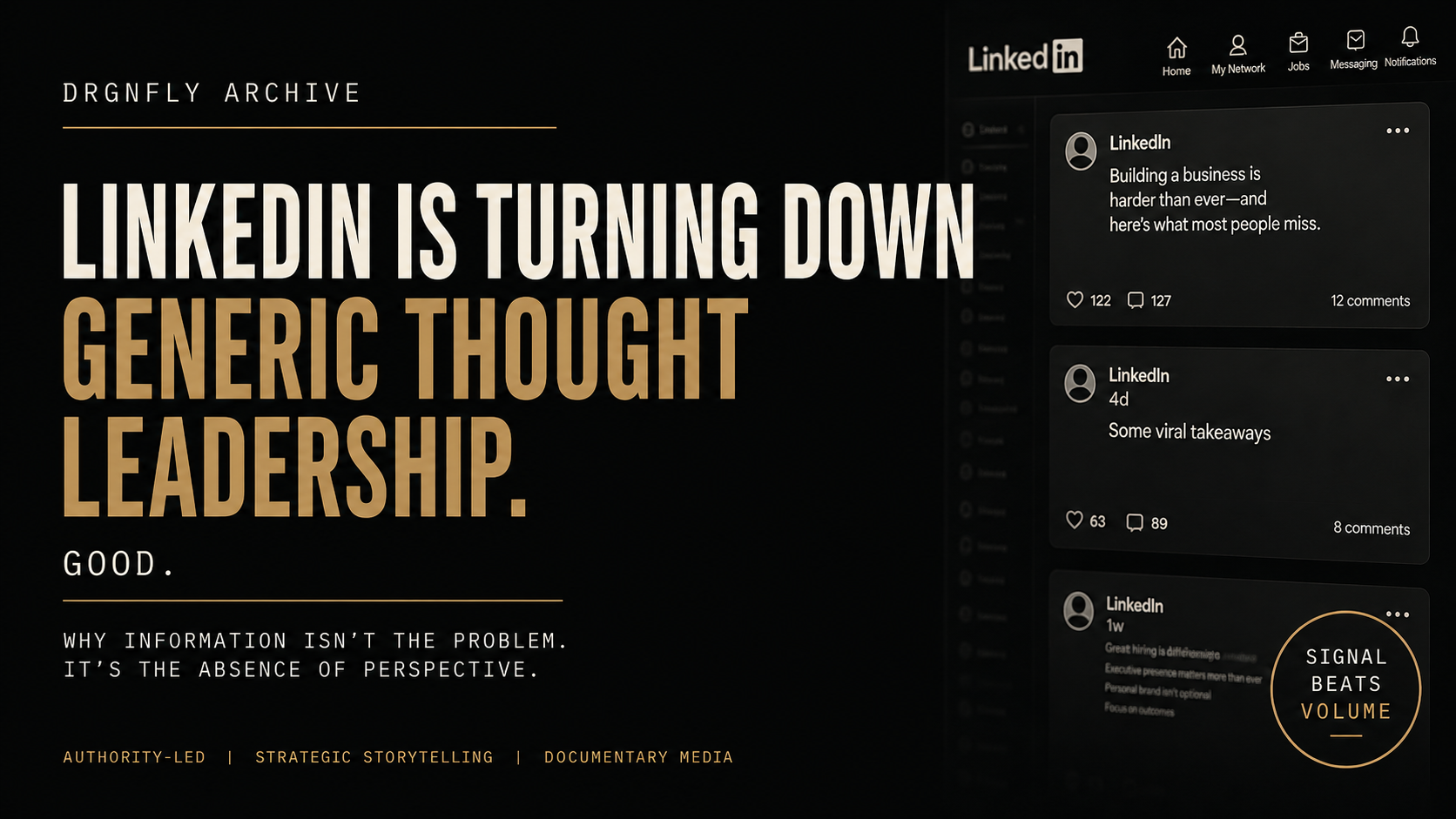
The problem with AI isn't that it can write. It's that it can make almost anyone sound like everyone else.
The problem with AI isn't that it can write.
It's that it can make almost anyone sound like everyone else.
Key Takeaways
- LinkedIn is actively reducing the distribution of generic content that lacks clear perspective. - AI hasn't reduced the value of expertise. It has reduced the value of sounding like an expert. - Founders have something generic AI content cannot manufacture: lived experience. - The strongest content increasingly starts with observation, not information. - Authority is becoming less about how much you publish and more about whether your thinking is recognisable.
Something interesting is happening on LinkedIn.
The platform has started actively dialling back generic content.
LinkedIn says its systems are being trained to distinguish between posts that add perspective, context or expertise and those that feel generic or repetitive, even when the writing itself appears polished.
It has also said that when something appears AI-generated and lacks clear perspective, it may be distributed less widely beyond the author's immediate network.
In LinkedIn's initial testing, it says those systems correctly identified generic content 94% of the time.
I think that's significant.
Not because LinkedIn has suddenly decided AI is bad.
It hasn't.
But because one of the world's biggest professional publishing platforms is effectively saying:
Competent content isn't enough anymore.
And I think that changes something for founders.
Sounding Like an Expert Has Become Cheap
For years, a certain kind of business content acted as a proxy for expertise.
A polished article.
A considered LinkedIn post.
A tidy framework.
A well-written explanation of an industry problem.
Producing those things required time, writing ability or access to somebody who could help.
Generative AI changed that.
Today, you can give an AI tool five bullet points and have something reasonably articulate back in seconds.
That's incredibly useful.
We use AI ourselves.
But there's an obvious consequence.
If everyone can produce the language of expertise, the language itself becomes less useful as evidence that expertise exists.
A polished post might represent twenty years of experience.
Or twenty seconds of prompting.
From the outside, the distinction isn't always obvious.
So audiences need other signals.
We Saw the Difference Again Recently
We spent part of a Saturday recently filming a founder interview with Jonny Sin.
There was no attempt to manufacture "thought leadership".
We talked.
Architecture.
Hospitality.
Relationships.
Building a business.
Why certain spaces make people feel something and others don't.
And as the conversation developed, ideas appeared that hadn't been written down beforehand.
Not because they were newly invented.
Because Jonny had been living them for years without needing to articulate them publicly.
That's something we've noticed repeatedly when interviewing founders.
The most interesting answer often isn't the first answer.
It comes after a pause.
After a story.
After somebody says:
"I've never really thought about it like that before."
That's the material I'm increasingly interested in.
Because an AI system can help shape those thoughts afterwards.
But it couldn't have lived the experiences that produced them.
Information Is No Longer the Scarce Part
We've used this line before:
Information informs. Interpretation creates understanding. Understanding builds trust.
It feels even more relevant now.
Information is abundant.
Want the accepted principles of hospitality design?
AI can explain them.
Want ten leadership lessons?
Done.
Want a summary of the biggest changes affecting your industry?
Seconds.
The interesting question is no longer:
What do you know?
It's:
What have you noticed because of what you know?
That's different.
The architect who has walked through hundreds of spaces notices something most of us don't.
The founder who nearly ran out of cash has a different relationship with payment terms.
The hospitality operator who has dealt with thousands of guests understands service in ways a textbook can't fully capture.
The creative who has spent twenty years making things develops instincts they may struggle to explain until somebody asks the right question.
That's where content starts becoming difficult to imitate.
LinkedIn's Direction Reinforces This
LinkedIn's own B2B guidance this year has been pushing toward people-powered thought leadership.
Its argument is that trusted practitioners, operators and experts help buyers make sense of complex subjects precisely because they bring real-world perspective—not simply polished brand messaging. LinkedIn also specifically recommends giving experts room to speak in their own voice rather than over-scripting them.
That interests us because it's very close to what we've been learning through the work itself.
The camera isn't always the most important part of founder media.
Sometimes the valuable part is creating enough space for somebody to think.
Then documenting what emerges.
Maybe We Need to Stop Asking "What Should I Post?"
That question almost invites generic content.
It starts with the empty box.
LinkedIn is empty.
What can we put in it?
I'd rather start somewhere else.
What happened this week?
What surprised you?
What did a client ask?
What went wrong?
What changed your mind?
What did you notice on a site visit?
What conversation stayed with you afterwards?
What do people outside your industry misunderstand about how your work actually happens?
Those questions lead somewhere much more interesting.
Because now the content begins with reality.
The post is simply where the thinking ends up.
Expertise Must Be Discoverable — But Also Distinguishable
We've had an idea sitting in the DRGNFLY Archive for some time:
Expertise Must Be Discoverable.
The original thought was that extraordinary knowledge creates limited influence when nobody can find it.
I still think that's true.
But AI has added another layer.
Being discoverable isn't enough if your thinking looks identical to everybody else's.
Your expertise also has to become distinguishable.
Over time, people should begin recognising:
the things you notice,
the questions you ask,
the stories you tell,
the positions you take,
the ideas you keep returning to,
and perhaps even the language you use to explain them.
That's when you're no longer simply producing content.
You're building a body of thought.
Use AI. Just Don't Let It Remove You.
This isn't an argument against AI-generated assistance.
Quite the opposite.
Use it to research.
Use it to interrogate an idea.
Use it to organise messy thinking.
Use it to find gaps in an argument.
Use it to improve something you genuinely want to say.
But there is a difference between using AI to sharpen your thinking and using AI to replace the need to think.
LinkedIn's latest changes are another reminder of that distinction.
The opportunity for founders isn't to compete with AI at producing perfectly structured information.
AI will win that contest.
The opportunity is to contribute something it can't generate independently:
experience interpreted by a human being who was actually there.
And perhaps that's where the next era of thought leadership is heading.
Less content created because Tuesday's publishing slot is empty.
More observations worth documenting because something genuinely happened.
Less polish for the sake of appearing authoritative.
More evidence of how somebody actually thinks.
Less noise.
More signal.
Related Articles
Why Human Perspective Is Becoming More Valuable Than Ever
As AI makes competent information increasingly abundant, judgement, lived experience and interpretation become more important sources of differentiation.
The Future Belongs to Category Interpreters
Information alone rarely creates authority. The people who help others understand what changing information actually means become the voices industries return to.
Signal Beats Volume
Publishing more isn't the same as becoming more valuable. Authority grows when the ideas being repeated are useful, coherent and recognisably yours.